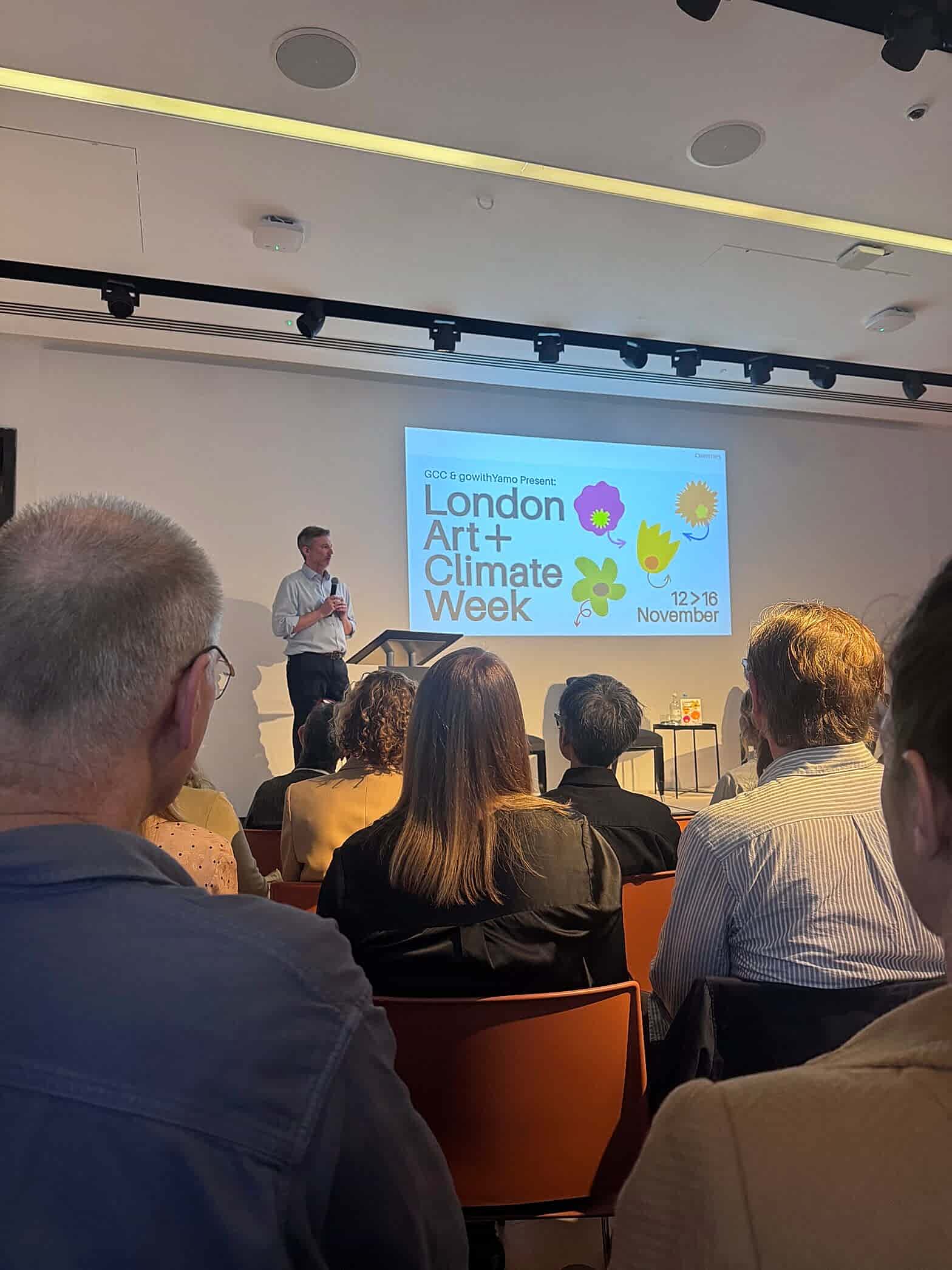
by Isher Dhiman, CVAN London
Panel: Frances Morris, Chair GCC, Heath Lowndes, Director of GCC, Danny Chivers, Environmental Advisor GCC
CVAN London were pleased to support the Gallery Climate Coalition (GCC) community at the launch of the stocktake report on 14 November 2025. The session explored how the cultural sector can confront the climate crisis, transform its institutional practices, and use its public influence to accelerate wider societal change. Central to the discussion was the urgent need for museums, galleries, and arts organisations to reduce emissions, end fossil-fuel sponsorship, and embed climate responsibility into their core missions.
Art, Activism, and Institutional Ethics
Frances Morris, Chair of GCC, reflected on the long-standing impact of climate activism within the arts, emphasising how campaigns such as Liberate Tate, exemplified by the powerful 2012 Turbine Blade intervention,have shifted ethical sponsorship debates into the mainstream. Like previous battles over tobacco funding, these actions underscored how cultural institutions can take principled stances that align with civic values. Art was described as a platform that “strikes the heart and impacts the head,” uniquely positioned to connect climate action with climate justice and to mobilise public imagination.
Collective Leadership and Sector Transformation
A key message was the need for collective leadership across organisations of all scales. The success of initiatives like the GCC lies in collaboration, with institutions supporting one another to transition to greener energy, develop sustainable practices, and overcome differing internal barriers. Leadership, the speakers stressed, does not only come from directors: it must be distributed across teams, departments, and networks. Role-modelling, practical case studies, and shared learning are essential to breaking down barriers and accelerating change.
Data, Measurement, and Cultural Behaviour Change
Improved data quality was highlighted as a cornerstone of progress. More accurate and comparable emissions datasets alongside metrics capturing social and economic impacts can drive behavioural change and support accountability. While the arts sector’s emissions are relatively small, its cultural influence is disproportionately high. Publicly engaging in climate action enhances institutional credibility and helps counter “pluralistic ignorance,” said Danny Chivers, where individuals underestimate how many others share their concerns.
Empowering Artists and Reimagining the Art World
The report emphasised the need to empower artists, who act as highly visible storytellers and catalysts for public engagement. Supporting artists financially, structurally, and creatively is essential to imagining an emerging art world capable of challenging orthodoxies and foregrounding climate justice. Institutions were encouraged to rethink exhibition-making through sustainable materials, circularity, and renewed commitments to public access and long-term value.
Systemic Change: Funding, Policy, and Future Visioning
Genuine transformation requires aligned funding, supportive policy frameworks, and the right expertise. While the sector is motivated, many organisations need structural support to scale up their efforts. Participants noted the importance of recognising progress such as advances in renewable energy and innovation, to counter disillusionment and maintain momentum. A forward-looking vision should centre on enabling artists to make a living, enabling the public to access art, and embedding sustainability into institutional missions.
Tools, Culture Change, and Collective Momentum
The GCC toolkit was recognised as a practical, easy-to-use resource that enables organisations to measure their impact, shape climate adaptation action plans and begin the behavioural changes needed for long-term transformation. Its convening power helps institutions build shared standards, foster collaboration, and cultivate a cultural shift where climate responsibility becomes normalised across the arts.
Digital Futures and AI
The session concluded by considering the opportunities and challenges of AI, with an emphasis on understanding and mitigating the digital emissions associated with rapidly expanding technological tools.
CVAN London’s commitment
London’s Contemporary Visual Arts Network is committed to supporting action plans for climate adaptation. In partnership with UCL CAVE (Controlled Active Ventilation Environment), we take a research-led approach to understanding how best to manage existing London’s cultural building stock that includes single glazing, Victorian halls, warehouses, 1970s uninsulated brick extensions and millennial buildings. An evidence-based approach will inform business plans and affect change. Aside from retrofitting, there are solutions to improve climate resilience; behavioural change within visual arts organisations will ensure that cost isn’t the primary driver.
If you would like to join a task and finish group to help CVAN London and UCL CAVE move this forward, please get in touch [email protected]