by Isher Dhiman, CVAN London
How the artist’s speculative ecosystems echo CVAN London’s call for a sustainable, future-ready arts sector
At this year’s Frieze London, one of the most quietly radical presentations came from Public Gallery: a solo project by the London-based artist Xin Liu. While fairs often lean toward the spectacular, Liu’s work offered something rarer, an ecology of thought, a living proposition about how humans – non-humans, and the systems that bind them might endure in the volatile futures we are hurtling toward.
Seen through the lens of CVAN London’s sustainability mission, which advocates for an arts sector grounded in environmental responsibility, research, and structural care, Liu’s installation emerges not simply as an artwork, but as a prototype for the kind of speculative, critical ecological thinking the sector urgently needs.
An Ecosystem Built as Argument
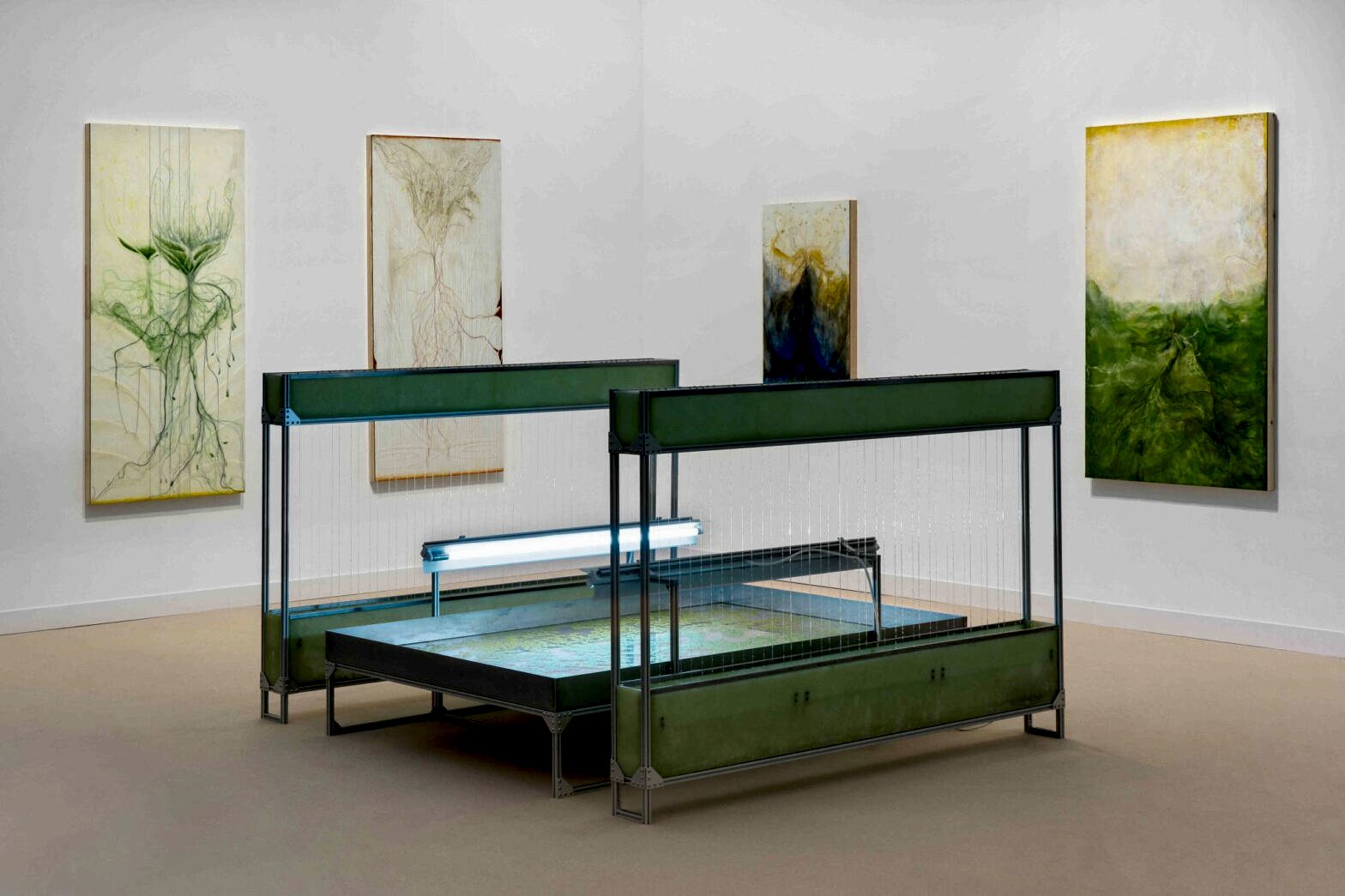
Liu transformed the booth into a functioning “metabolic” environment: a steel tank cultivating fast-replicating duckweed, streams of viscous liquid released from paired structures, and surrounding works that traced the invisible architectures of life.
Duckweed, a species often maligned as invasive, becomes the axis of her “cosmic metabolism,” a concept that parallels planetary processes with microbial ones. Under her framing, the plant shifts from nuisance to asset: a resilient organism with potential as a future food source, biofuel, or off-planet resource.
Here, Liu performs a subtle act of ecological revaluation. She invites viewers to consider how cultural, scientific and economic systems decide what constitutes “useful” or “desirable” life and how those categories may shift as the climate crisis forces new priorities.
This destabilisation of value maps directly onto CVAN London’s sustainability values, which encourage the sector not simply to reduce carbon impact, but to fundamentally rethink relationships to materials, resources, labour, and the ecologies we inhabit.
A Model for Sector-Wide Transformation
CVAN London’s sustainability focus asserts the need for “research-led, multidisciplinary approaches” to climate adaptation and environmental care across the visual-arts ecosystem. Liu’s installation, with its experimental biology, technological inquiry and self-contained flows of growth, scarcity and renewal, performs precisely this kind of cross-disciplinary thinking.
Her self-contained ecosystem argues for systems awareness: that sustainability in the arts cannot be reduced to tokenistic gestures, but must include remaking the infrastructures that organise production, exhibition, circulation, and value.
If exhibitions behaved more like Liu’s metabolic tableau, iterative, responsive, regenerative; the sector might begin to approach the kind of structural sustainability that CVAN London promotes: one attentive to long-term survival, interdependence, and shared futures.
Speculation as Stewardship
What ultimately makes Liu’s contribution so compelling in the context of CVAN London’s climate advocacy is its insistence that sustainability is not just about protecting what already exists. It is also about imagining what else might be possible.
Her “cosmic metabolism” does not mourn ecological loss so much as prototype ecological alternatives: adaptive organisms, hybrid systems, new value logics, speculative futures in which life; microbial, vegetal, human, planetary, must reconfigure itself to endure.
This imaginative dimension is essential. Without it, sustainability risks becoming an exercise in compliance rather than transformation. With it, the visual arts become a site of experimentation, a place where new ecological, social and technological futures can be modelled before they are lived.
Toward a Regenerative Arts Ecology
Liu’s installation at Frieze London, in its quiet complexity, exemplifies the kind of artistic practice that networks like CVAN London seek to champion: rigorously researched, ecologically attuned, and structurally inquisitive. It demonstrates how art can illuminate the entangled crises of our moment and more importantly, how it can model new forms of coexistence, care and survival.
As the arts sector confronts climate instability, economic volatility and structural inequities, works like Liu’s gesture toward a new paradigm: one in which sustainability is understood as a collective act of imagining, building and metabolising new futures. Her duckweed tank, viscous flows and tangled networks remind us that regeneration is rarely clean, linear or predictable but it is possible, and it is necessary.
CVAN London’s Commitment
CVAN London remains committed to championing the kinds of research-driven, future-oriented ecological thinking embodied in Xin Liu’s Cosmic Metabolisms. In our work with organisations, artists, and policy partners across the city, we continue to advocate for a visual-arts sector that is both environmentally responsible and structurally resilient. As with our collaborations on climate adaptation, we believe that meaningful sustainability requires not only technical solutions, but also cultural ones: new imaginaries, new systems of value, and new ways of understanding our entanglement with planetary processes.
To build this future, we are expanding interdisciplinary dialogue across London’s arts ecology, bringing together artists, researchers, ecologists, architects, technologists and cultural leaders to explore models of regenerative practice.
If you are interested in contributing to this work, collaborating on research, or joining an emerging task-and-finish group focused on sustainable cultural infrastructures, we would be delighted to hear from you at [email protected]